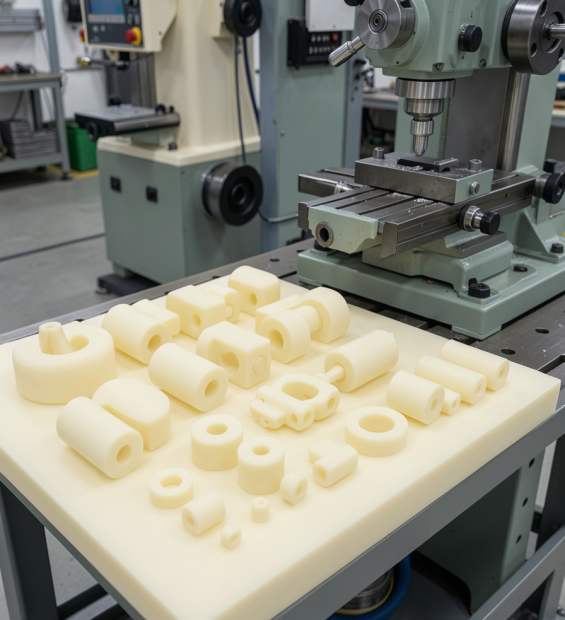
PTFE

Key Properties of PTFE

Icon
Excellent chemical resistance
Icon
Extremely low friction coefficient
Icon
High temperature resistance
Icon
Non-stick surface characteristics
Icon
Excellent electrical insulation
Icon
Good dimensional stability
Icon
Resistance to moisture and UV exposure

These properties make PTFE suitable for critical applications involving aggressive chemicals, sliding contact, and thermal stress.

Applications

PTFE Industrial Applications

PTFE components are widely used across industries such as:

Chemical processing equipment
Icon
Pharmaceutical machinery
Food processing and packaging systems
Icon
Electrical and insulation components
Icon
Sealing and gasket applications
Wear parts and sliding components

Its inert nature makes PTFE ideal for applications requiring chemical compatibility and contamination-free performance.

PTFE PRODUCTS OFFERED

PTFE Stock Shapes

Plastic Engineering Solution supplies Ultra-High Molecular Weight Polyethylene (UHMWPE) in multiple stock shapes and machined forms, including:

Icon

PTFE Plate

(2mm - 80mm thickness)
Icon

PTFE Rods

(6mm - 200mm diameter)
Icon

PTFE Bush

(OD - 32mm x ID - 12mm x LT - 150mm TO
OD - 444mm x ID - 317mm x LT - 153mm)

All PTFE products are supplied and machined to support industrial applications requiring abrasion resistance, impact strength, low friction, moisture resistance, and long service life.

AVAILABLE GRADES

PTFE Grades Supported

We support a range of PTFE material grades, including:

Icon
Virgin PTFE
Icon
Filled PTFE grades (Glass-filled, Carbon-filled, Bronze-filled, etc.)
Icon
Application-specific PTFE formulations
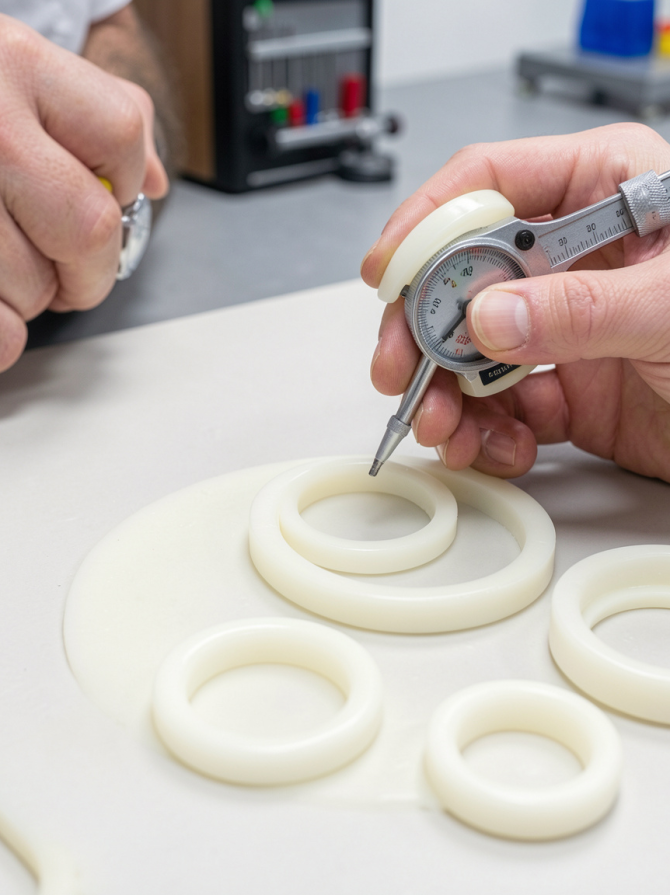
Our team assists with grade selection based on wear resistance, load conditions, and chemical exposure.

magnific_closeup-of-technician-ins_CHTszqxEEy
magnific_professional-plastic-engi_WMJmLFOcXe
Machining capability

PTFE Machining

PTFE requires specialized machining techniques due to its softness and creep behavior.

Our PTFE machining capability includes:

We optimize machining parameters to achieve clean finishes, accurate dimensions, and reliable component performance.

Tolerance information

PTFE Machining Tolerances

PTFE machining tolerances depend on:

Component geometry

Wall thickness

Application requirements

Operating conditions

Typical achievable tolerances are maintained as per design feasibility.

Detailed tolerance information can be provided during the RFQ stage.